She Knew 150 Bible Verses by Heart. She Hadn't Believed Any of Them Since She Was 12.

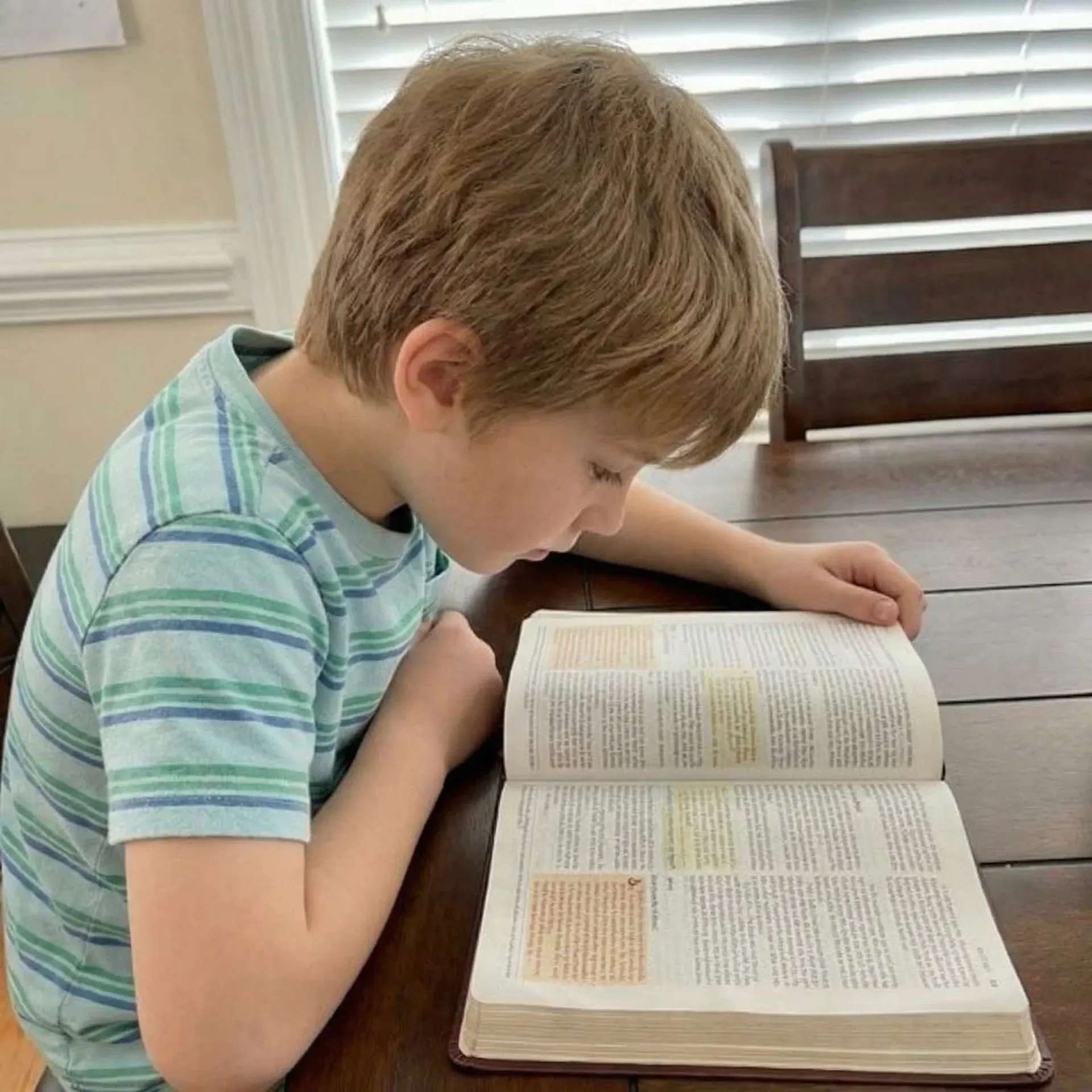
If you have a child between 6 and 14 in church every Sunday...
If you believe knowing Bible stories equals strong faith...
If you've felt that quiet, nagging dread watching your child go through the motions...
If you've tried more programs, more activities, more devotionals — and still felt something slipping...
Then what I'm about to share could be the most important thing you read this year.
73% of kids raised in Christian homes abandon their faith by age 18.
But this isn't about rebellion, college professors, or peer pressure.
This is about a fundamental flaw in how we teach faith to children. One that begins destroying belief quietly, invisibly, when they're just 8 years old.
I know this — because I already lost one child to it.
And I almost lost my second one too.
The Night Everything Fell Apart
My name is Jennifer. I'm a mom of two — Emma, now 18, and Caleb, 9.
The night before Emma left for college, she asked if she could talk to me.
We sat on the edge of her bed surrounded by packed boxes, and she said:
"Mom, I need to tell you something before I go. I stopped believing — I don't even know, maybe when I was 12 or 13. I just never knew how to tell you."
I didn't say anything. I couldn't.
Twelve or thirteen. Six years of Sunday school. Six years of youth group. Six years of family devotions and mission trips and worship leading — and she had already quietly, privately, walked away.
"Did we do something wrong?" I asked.
She looked at me with something that wasn't anger. It was almost pity.
"No, Mom. You did everything. That wasn't the problem."
I sat on her bed for a long time after she fell asleep. Trying to figure out what that meant.
I Thought More Would Fix It
Two months later, Caleb — my 9-year-old — looked up from his homework at the kitchen table and said:
"Mom, how do we actually know God is real? Like, actually know?"
And I felt it again. That cold drop in my stomach.
I said what I always said. Something about faith. Something about how we feel God's presence. Something that sounded right.
He nodded politely and went back to his homework.
That night I couldn't sleep. Because I recognized that nod. Emma used to do it too.
So I did what any desperate mom does. I signed him up for more.
I enrolled him in a midweek kids' program at our church. Bought a new devotional with colorful illustrations. Started doing family Bible time three nights a week instead of one.
For three weeks, I watched him show up. Sit. Listen. Nod.
Same nod.
The programs were warm and well-meaning and full of songs and crafts and good-hearted people. But none of them answered his question. Not once. Not even close.
I pulled his youth group leader aside one Sunday and told her what Caleb had asked.
She smiled and said, "That's so sweet that he's curious. We'll pray for his faith to grow."
I drove home and cried the whole way.
I didn't need someone to pray for his faith to grow. I needed someone to help him understand why there was something to believe in.
There was a difference. And I was starting to realize nobody around me could see it.
What I Finally Understood
I started researching. Desperate, middle-of-the-night research. Forums, studies, anything.
What I found stopped me cold.
Between ages 6 and 14, children's brains undergo what neuroscientists call "the cognitive shift."
They stop accepting information because adults say it's true. They start asking "why" and "how do you know?"
Dr. Patricia Goldman at Stanford found that this is when children develop their "epistemic framework" — their internal system for deciding what's true and what isn't.
If they don't develop reasons for faith during this window, they'll find reasons against it later.
And here was the part that made me feel sick:
99% of children's ministry focuses on WHAT to believe. Not WHY.
Emma hadn't failed. I hadn't failed. The programs had failed — because they were never designed to do what I thought they were doing.
They were designed to give children stories. Not foundations.
There's a difference. And I had watched that difference destroy one of my children's faith from the inside out over six silent years — while I stood there handing her more stories and wondering why nothing was sticking.
The Resource That Was Hidden From Me
I was up at 1:47am when I found it.
A thread on a homeschool forum. A mom describing exactly what I was going through — the nodding, the going-through-the-motions, the questions that never got answered. And someone had replied with a name I'd never heard of.
The Systematic Theology workbook series.
Designed specifically for ages 6–14. Built by a team of apologists, theologians, and child psychologists together.
I read through the whole thread, then another one. And the more I read, the more a strange feeling built in my chest that wasn't quite hope yet. It was closer to anger.
Because this resource had been around. Parents of kids in elite Christian schools knew about it. Families who ran in apologetics circles knew about it. Homeschool co-ops were buying it in bulk.
But nobody had ever told me it existed.
Not my pastor. Not our youth director. Not the women's Bible study I'd been attending for eleven years.
A tool specifically designed to answer the questions my children were asking — and I had to find it alone at 2am, sobbing over a keyboard, after one daughter had already gone.
What Makes It Different From Everything Else
This isn't another Bible storybook.
It's a systematic worldview curriculum built around what psychologists call "constructive learning" — the discovery that when children find truth themselves through guided activities, their brains form permanent neural pathways.
When we just tell them facts, it stays in short-term memory. When they discover it, it becomes part of how they think.
Each lesson uses a three-step method called Discovery Theology:
- Wonder — Start with a real question kids actually ask. Not a soft question. The hard ones.
- Discover — Guide them to find answers through activities and evidence, like junior detectives
- Connect — Show how this truth changes the way they see real life
Instead of telling kids "God exists," it guides them to discover evidence for God themselves.
Instead of saying "The Bible is true," it teaches them how to evaluate truth claims.
Instead of demanding blind faith, it builds reasonable faith.
Kids don't just learn Christianity. They learn to think Christianly.
This is how schools teach math and science. We've just never applied it to faith.
The Moment I Knew It Was Different
I ordered it. It arrived on a Thursday.
That Saturday morning I sat down with Caleb at the kitchen table — the same table where he'd asked his question, where I'd given him my hollow answer — and we opened it together.
The first lesson didn't start with a Bible verse. It started with a question:
"How do you know anything is real?"
Caleb looked at me. "Wait, is this a trick?"
"I don't know," I said. "Let's find out."
Forty-five minutes later, we were still at the table. He hadn't checked his phone. He hadn't asked when we'd be done. He was leaning forward, both elbows on the table, arguing with me about whether you could prove something existed if you couldn't touch it.
He was nine years old and he was doing philosophy. Real philosophy. Because someone had finally given him a question worth thinking about.
Three weeks later, he came home from school and dropped his backpack by the door.
"Mom, Tyler said there's no proof God exists."
My stomach tightened. Here we go.
"What did you say?" I asked.
He shrugged. "I told him about the cosmological argument. He said it was actually a pretty good point."
The cosmological argument. My 9-year-old. To his friend. At recess.
I turned back to the stove so he wouldn't see my face.
That was the moment I understood what I'd been missing for eighteen years.
It was never about getting my kids to believe more.
It was about giving them reasons to believe at all.
The Window Is Still Open — But Not For Long
Every week your child between 6 and 14 goes without theological foundation is one week closer to a future you don't want.
Those neural pathways are forming right now.
Either with reasons for faith — or reasons against it.
There is no neutral ground.
Emma is in her second year of college. We still talk. I still pray. That story isn't over.
But she is 18, and the window that closes at 14 closed four years ago.
Caleb is 9. His window is wide open.
And for the first time since that night on Emma's bed, I am not afraid.
The Cost of Waiting
I know what it feels like to think Sunday School is enough.
To tell yourself the programs are working.
To see the nodding and assume it means yes, when it actually means I don't have an answer so I'll just agree.
Emma graduated with 200 Bible verses memorized and not a single reason to believe any of them.
That didn't happen because I didn't love her enough, or pray enough, or show up enough.
It happened because no one ever handed her the right tool.
I have Caleb. You still have your child.
Don't wait until there's a packed box on a college bedroom floor.
[Secure Your Child's Faith Foundation — 50% Off →]
The research is clear. The window is real. The solution works.
The only question is whether you act before the window closes.
[Get The Workbook Now — Limited Copies Remaining →]
— Jennifer, mom of two. Still praying for Emma. Not waiting with Caleb.
Results may vary. Individual experiences shared represent personal testimonials and are not guaranteed outcomes for all users.